
The Fibre that Binds Us
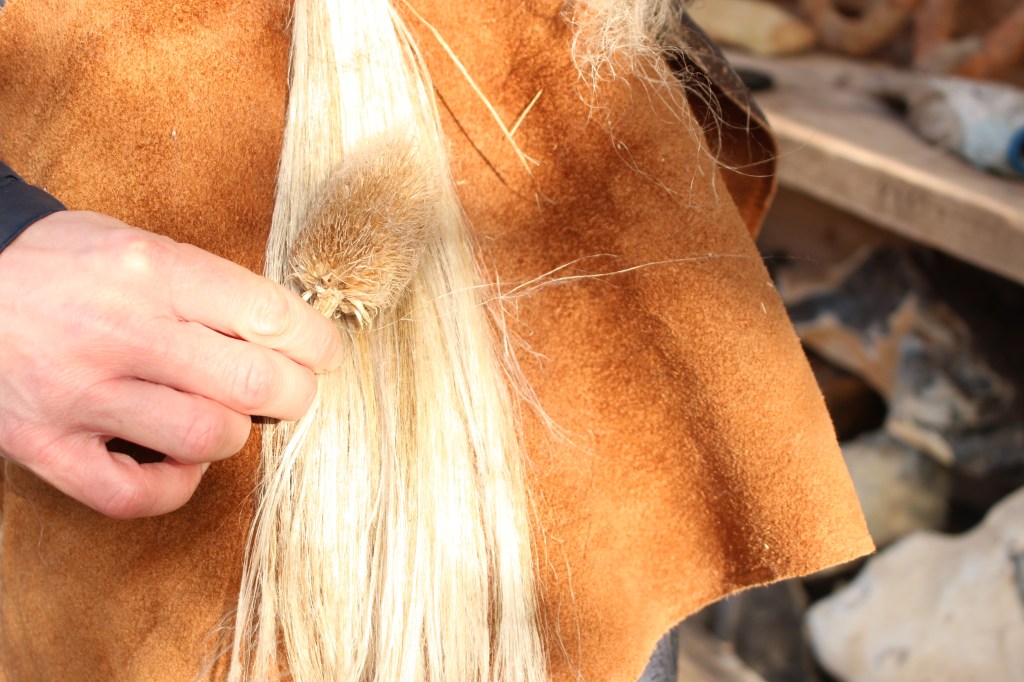
Combing Flax with the Stiff Teasel plant on leather.
Flax is an incredible and ancient plant that has been adapted over millennia and in partnership with humans and technology. To study the history of the flax plant and the linen derived from it is to discover the history of people. The plant has value as food, fibre, and fodder, and it was named by botanists to reflect its many utilities: Linum usitatissimum (flax, very useful). The earliest examples of woven linen textiles date to approximately 32,000 years ago, so the plant and all the many skills involved in its preparation for spinning and weaving have been kept alive and with us for longer than memory.
Taking flax from a plant to a fibre is a wonderful, but not always entirely intuitive process. The retting of flax, that is, the controlled rotting of the outer fibres in order to access the inner, lustrous spinnable fibres is a difficult task in terms of timing, that can dramatically impact the quality of the finished materials.
In the Flax section of the website, you will find a step by step journey of our research into how stone age people might have taken flax from seed to textile. We sow, grow, ret, break, scutch, heckle, spin and weave our way towards…a finished woven garment.
In the GROWING section, we outline our process of growing and retting 100 square metres of flax in the 2022 season, and will update the page with our 2024 experiences of sowing, growing, harvesting, and retting. There is a global shortage of flax fibre seed this year so we are very grateful to Flaxland for making 100 square metres worth of seed available to us for our education work.
After growing, retting and drying the flax, other processes are required to get to the lovely hair-like bundle of fibres. The names used for these processes derive more from the medieval industry and tools used for flax processing. These are:
– breaking (literally breaking the stiffness of the outer straw layer)
– scutching (beating the bunch with a wooden paddle to release and remove the broken straw layers)
– heckling/hackling: (drawing the bunch through a table-mounted comb made of long nails)
I describe these processes in the PROCESSING pages.
As 2024 progresses, I will write about the SPINNING process, on the leg at its most basic, and on homemade spindles as this develops. Followed by some experiments in natural plant dyeing.
Finally, I will document the warp-weighted loom I have built and upon which I have learnt WEAVING.
 The Prehistoric Workshop