

After the flax has been retted and dried, you can begin to process it, that means, remove the outer straw layer and comb the inner fibres until they are organised and soft. In this case, we are using only tools available to stone age people, that is, a stone with a blunt/cornered edge to break the flax, and the wonderful stiff teasel plant to comb the flax.
Breaking and scutching
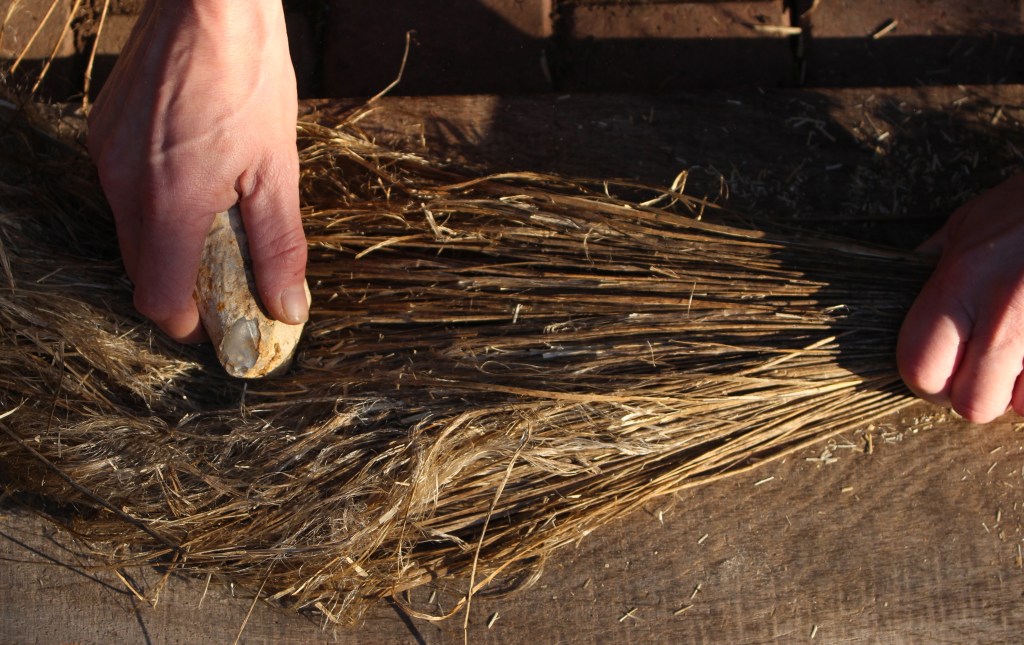
Start by grabbing a bunch of flax that you can comfortably hold and grip with one hand. Break the initial stiffness of the stems by bending all along the bunch, then work the tip end first with the stone in your strongest hand. Wrap the root end of the bunch around your other hand a few times to ensure you don’t comb out large bunches of fibre from the middle of the bundle as you work. Scrape toward the tip repeatedly, clearing your working surface of shives as you go.
Release more of the bunch to work as needed and give it a shake and a whip to release debris. Turn the bundle so that this time you can work from the middle of the bunch to the root end. The roots can be snapped off by hand (time-consuming but most effective), and then the stem can be scraped to the end using the stone. The stone has the advantage of aligning the fibres well at this stage. You want to use the stone to remove at least 60 to 70 percent of the stem material that encases the long flax fibres before moving on to the teasel for finishing. During the scraping, 20 to 30 percent is combed out as tow (short flax fibres) that can be put aside for coarser spinning.
Combing/heckling/hackling


The stiff teasel grows in abundance in the UK countryside, and, being a biennial, the plants are best used after they have died following flowering in their second year. Cut a flower head, leaving a few centimetres of stalk. Run a piece of leather up and down the stalk to remove the irritating spikes and snap off the basal leaves below the flower. Drape the scutched flax over your leg and using the teasel “upside down” to create less friction, comb downward briskly but lightly. Turn the teasel the other way round for coarser combing at the root end of the flax. Large tangles are best pulled out by hand if they can’t be combed through.
Work until there is no debris left. During the teasel combing, another 20 percent or so comes away as incredibly soft tow. The remainder of the bunch is a beautiful and lustrous strick of flax, and it is at this point in the process that I understand why people use the phrase “flaxen hair.”


By the end of the teasel combing, the flower head is worn and soft and makes the perfect brush for finishing off and almost polishing the strick. It is, however, now redundant as a heckling comb and best used as tinder for a fire!
 The Prehistoric Workshop